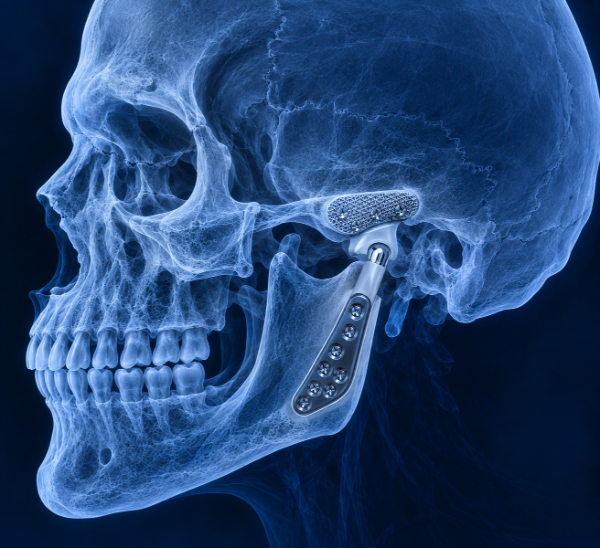
TMJ replacement is a surgery that replaces a severely damaged jaw joint with an artificial joint designed to restore movement and function. The temporomandibular joint, or TMJ, is the joint located just in front of the ear that connects the lower jaw to the skull and allows the jaw to open, close, and move from side to side.
TMJ replacement may be considered for patients with advanced degenerative joint disease, severe arthritis, ankylosis or fusion of the joint, significant joint destruction following trauma, certain developmental or structural abnormalities, or previous TMJ surgeries that have not provided adequate improvement. Because every TMJ condition is different, joint replacement is recommended only after a comprehensive evaluation of the patient’s symptoms, anatomy, function, and treatment history.
Request an AppointmentDuring total TMJ replacement, the damaged portions of the natural joint are reconstructed using prosthetic components designed to restore the relationship between the lower jaw and the skull. Similar in concept to replacement of other joints in the body, the procedure creates a new functional articulation that allows the jaw to move without relying on the severely compromised natural joint surfaces.
In some cases, TMJ replacement may also be coordinated with corrective jaw surgery or other reconstructive procedures when joint disease has affected the patient’s bite, jaw position, or facial symmetry. Looking beyond the joint itself allows treatment to address the broader structural and functional effects of advanced TMJ disease.
The goal of TMJ replacement is not simply to replace a damaged joint, but to restore a stable foundation for healthier jaw function. For appropriately selected patients, treatment may help improve jaw movement, chewing ability, bite stability, and overall quality of life while reducing limitations associated with severe joint disease.
At SFIOS, TMJ replacement is approached as a highly individualized reconstructive treatment. From diagnosis and digital planning through surgery and recovery, our focus is on restoring function, improving stability, and creating a carefully planned long-term solution for patients with complex TMJ conditions.